HomeResearch
Research
OVERVIEW
Overview
As the information society develops, the volume of traffic carried over optical fiber networks keeps growing exponentially, and building optical fiber networks of far greater capacity has become an urgent task. The Hasegawa Laboratory addresses a range of challenges in realizing the high-capacity optical fiber networks that the next generation will require.
RESEARCH 01 / 04
Optical routing
- ROADM (reconfigurable optical add-drop multiplexer)
- Optical cross-connects
- Wavelength-selective switches
- Optical switches in datacenters
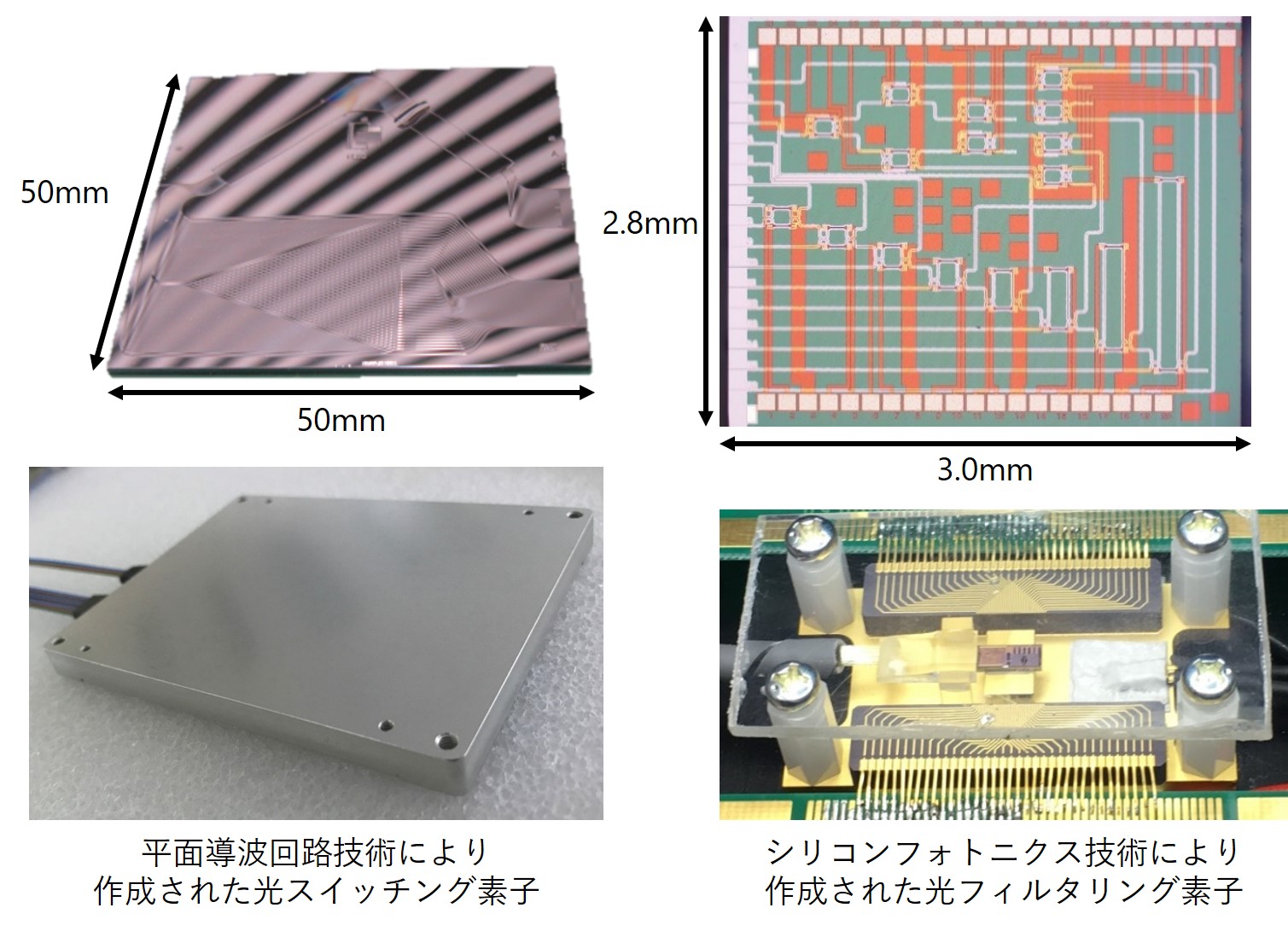
To carry information quickly and reliably over optical fiber networks, optical routing equipment that steers the paths of optical signals is indispensable. Processing signals entirely in the optical domain, without converting them into electrical signals, allows very large volumes of traffic to be switched with little power. In 2017 we proposed an optical node based on an entirely new architecture and confirmed its effectiveness in transmission experiments; the work was selected as a Top-Scored Paper at ECOC 2017, one of the largest international conferences on optical communication. In 2019 we went on to propose and demonstrate optical switching equipment with a total throughput of 2.15 Pb/s, a world record at the time of its presentation and enough capacity to deliver 4K broadcasts to 60 million people simultaneously.
RELATED PAPERS
- Low-Loss and Incrementally Expandable Flat Modular OXC for Scalable Metro-Core Optical NetworksA. Wada, T. Kuno, Y. Mori, and H. Hasegawa — IEEE/Optica Journal of Optical Communications and Networking, 2026.
- Three-Stage Optical Circuit Switch Architectures for Intra-Datacenter NetworkingT. Mitsuya, R. Higuchi, T. Kuno, T. Ochiai, H. Yuasa, Y. Mori, and H. Hasegawa — IEEE/Optica Journal of Lightwave Technology, vol. 43, no. 2, pp. 400-407, January 2025.
- Flexible waveband routing node architecture for spatial-division and multi-band optical networksH. Hasegawa — IEEE/Optica Journal of Optical Communications and Networking, vol. 16, no. 7, pp. C20-C30, July 2024.
RESEARCH 02 / 04
Optical transceivers
- Digital coherent reception
- Digital signal processing
- Signal regeneration
- Laser phase noise and IQ imbalance
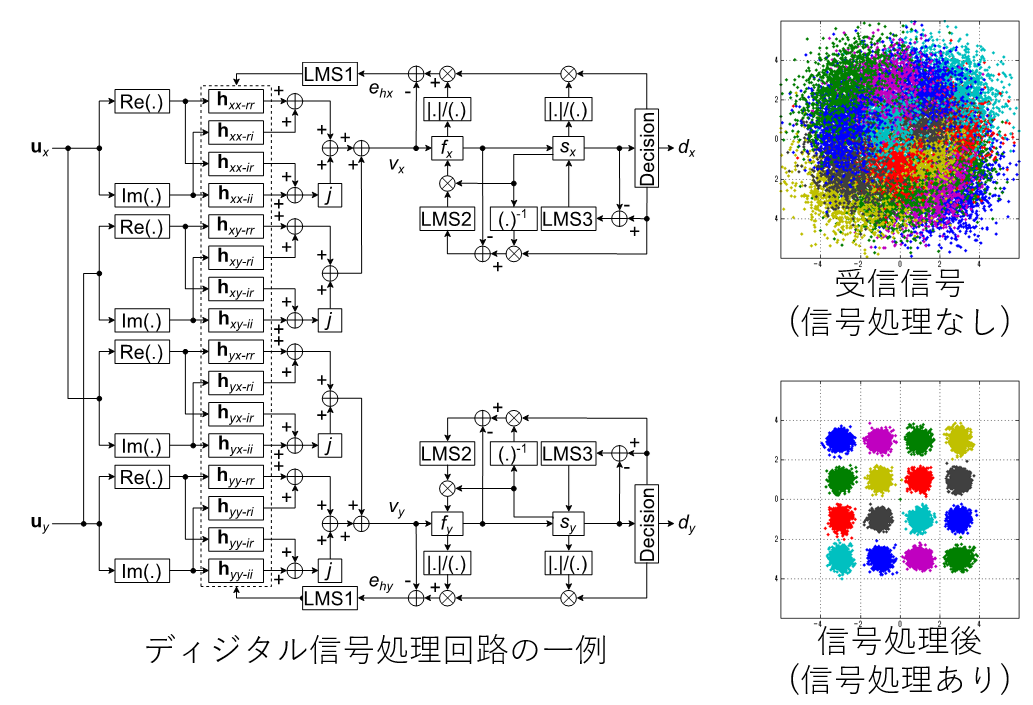
The digital signal processing performed inside transceivers is essential to achieving the required signal quality. It must deal with every cause of signal degradation that arises in a communication system: the phase and frequency instability of lasers, the non-ideal characteristics of optical and electrical components, waveform distortion from fiber transmission, and more. The signal-regenerating digital signal processing algorithms we have proposed make it possible to obtain signals of exceptionally high quality. This technology was used in a 2017 experiment that achieved transmission of 10.16 Pb/s over a single optical fiber, contributing to what was then a world record.
RELATED PAPERS
- Split-Sideband Digital Subcarrier Multiplexing for IQ-Impairment Compensation without Inter-Subcarrier MIMOT. Kuno, T. Sekizuka, Y. Mori, and H. Hasegawa — European Conference on Optical Communication, paper We4-P54, Málaga, Spain, September 2026.
- Digital Coherent Receiver Enabling Nyquist Wavelength Demultiplexing Under Frequency Offset and Receiver-Side IQ ImpairmentsT. Kuno, Y. Mori, and H. Hasegawa — IEEE/Optica Journal of Lightwave Technology, vol. 42, no. 5, pp. 1409-1422, March 2024.
- Demodulation framework based on machine learning for unrepeated transmission systemsR. Shiraki, Y. Mori, and H. Hasegawa — IEICE Transactions on Communications, vol. E107-B, no. 1, January 2024.
RESEARCH 03 / 04
Optical links
- Nonlinear optical effects
- Optically amplified transmission
- Analysis of transmission characteristics
- Limits of capacity and transmission distance
Optical fiber is a communication medium of extremely low loss; its transparency is said to exceed that of clear air. Because of this low loss, almost every long-distance communication system is built on optical fiber. In long-distance systems, however, the long interaction length between light and the medium makes nonlinear optical effects pronounced: light entering a nonlinear medium induces a polarization that makes its propagation speed depend on its intensity. The waveform of the optical signal is distorted as a result, which limits both the capacity and the distance of communication. We seek to understand the physics of light in optical fibers and to clarify the limits of the capacity and distance of communication systems. Such analysis of transmission characteristics is also essential for controlling networks efficiently.
RELATED PAPERS
- Spectrum Narrowing Mitigation via Opto-Electrical Hybrid Partial-Response Spectrum Shaping and RNN-Based Sequence EstimationT. Sekizuka, T. Kuno, Y. Mori, and H. Hasegawa — IEICE Transactions on Communications, vol. E109-B, no. 11, November 2026.
- Network-Level Impact of EDFA Gain Fluctuations under Dynamic RWA in High-Symbol-Rate WDM NetworksT. Sekizuka, S. Shimoi, T. Kuno, H. Hasegawa, and Y. Mori — European Conference on Optical Communication, paper We3-A4, Málaga, Spain, September 2026.
- EEPN-Aware In-Service Estimation of Transmitter and Receiver Laser Linewidths Using Coherent Receiver DSPT. Sekizuka, T. Kuno, H. Hasegawa, and Y. Mori — IEEE/Optica Journal of Lightwave Technology, Early Access, 2026.
RESEARCH 04 / 04
Network control
- Routing and wavelength assignment (RWA)
- Wavelength continuity
- Spectral efficiency
- Control by machine learning

Optical fiber networks provide economical communication through wavelength-division multiplexing, which combines signals of many different wavelengths into a single fiber. The frequency band available for optical fiber communication is becoming scarce, however, so using that limited band effectively is essential for higher capacity. Packing wavelength-division multiplexed signals densely along the frequency axis raises capacity, but at a price: when optical signals are routed, the quality of their neighbors on the frequency axis suffers. Moreover, in networks that route signals while they remain light, each signal must keep the same wavelength from transmitter to receiver. Maximizing the transmission capability of an optical fiber network therefore calls for control that oversees the whole network, taking into account both the influence of neighboring signals in the frequency domain and the use of consecutive links in the spatial domain. We aim to realize high-capacity optical networks by devising control algorithms that respect the constraints peculiar to optical fiber networks; we have recently proposed machine-learning-based control methods and are now validating them.
RELATED PAPERS
- Dynamic routing and wavelength assignment in optical networks: from capacity limits to flow-based controlY. Iida, S. Shimoi, H. Yuasa, T. Kuno, Y. Mori, and H. Hasegawa — IEEE/Optica Journal of Optical Communications and Networking, vol. 18, no. 9, pp. D56-D67, September 2026.
- Hybrid FXC-WXC Networks with Selective Wavelength Conversion: Dynamic Path Control and Experimental DemonstrationR. Hosokawa, S. Shimoi, T. Sekizuka, K. Mano, T. Kuno, Y. Mori, K. Hosokawa, S. Yanagimachi, and H. Hasegawa — European Conference on Optical Communication, paper Mo5-H4, Málaga, Spain, September 2026.
- GNN-Based Bounded Maximum Flow Approximation for Routing and Wavelength Assignment in Dynamic Optical NetworksY. Iida, S. Shimoi, H. Yuasa, T. Kuno, Y. Mori, and H. Hasegawa — SPIE Photonics West, paper 13905-6, San Francisco, USA, January 2026.